How Edmonton's Lucid Rain Studios Is Building INFERIUS
Meet Delena Martens, co-founder of Lucid Rain Studios, and the story behind INFERIUS, the Edmonton psychological horror game returning to gamescom after a standout showing at Game Con Canada.
Meet Delena Martens and the team behind INFERIUS, the Edmonton-made psychological horror game that recently won Best Game from CGMagazine and first place in the Big Indie Pitch at Game Con Canada.
Last year, Lucid Rain Studios made it to gamescom for the first time, new to the event and figuring out as they went. They came away having learned a lot, and with a clear sense of what they wanted to bring back.
This August, they’re returning with that experience behind them, a stronger, more polished build, a year of production, and support from Edmonton Screen’s Summit Push Program.
“Last year was still a great experience. We took a lot away from it,” says Delena Martens, co-founder, Chief Creative Officer, and Audio Director.
This time, she says, they’re ready to show INFERIUS the way they always wanted to.
Building Fear Through Sound
Ask Martens what makes a horror game work and she won’t start with the monsters. She’ll start with the sound.
Before games, her world was music. She trained as a vocalist and spent years composing, arranging, and coordinating live productions, learning how to pull emotion out of an audience through sound. It clicked in her final year at MacEwan, in a film and game scoring class.
"I was like, man, I should have been doing this from the start."
That background now shapes INFERIUS, a psychological horror game built around tension, uncertainty, and the fear of the unknown.
"Sound is energy," Martens says. "It's communicating directly to your brain, but it's also communicating to your body."
Which is why one of the most powerful tools she has is silence.
"You can do so much with silence. You are literally in your own head, freaking yourself out, because nothing is giving you other feedback."
The sounds themselves come from unexpected places: metal scrapes, manipulated recordings, and a friend's terrible dishwasher.
"That's how you get sounds no one's heard."
Building a Studio Around INFERIUS
Lucid Rain Studios was founded during the COVID-19 pandemic by Martens and brothers Rosche and Ricardo Rheeder. The three brought different strengths to the table and a shared love of horror and strategy games.
INFERIUS began as a 72-hour game jam project, a card game inspired by a descent through the nine circles of hell. The concept stuck, and as the game evolved, so did the studio.
The current version of INFERIUS takes its own interpretation of Dante's "Inferno”, pairing it with Lovecraftian dread: the fear of the unknown, the feeling of being small against something ancient and incomprehensible. You play a Pilgrim in a world that opposes you at every turn, and you can't really fight back. Survival comes down to your resources, your deck, and your nerve.
What started as three people has grown into a team spanning creative, art, audio, programming, marketing, and business development. Building INFERIUS meant building the studio behind it at the same time.
Support from the Canada Media Fund carried the project into active production and gave the team the stability to focus on development. Today, INFERIUS is fully funded and targeting a mid-2027 release. As for the studio itself, Martens says it’s in the "teenager phase": past the growing pains, confident in its direction, but still growing into what it can become.
What’s Next for Lucid Rain
Edmonton Screen first supported Lucid Rain during the prototype stage of INFERIUS through a Community Development Grant, helping fund early marketing efforts while the future of the project was still uncertain.
"Edmonton Screen has always been a very constant partner," Martens says. "That's rare."
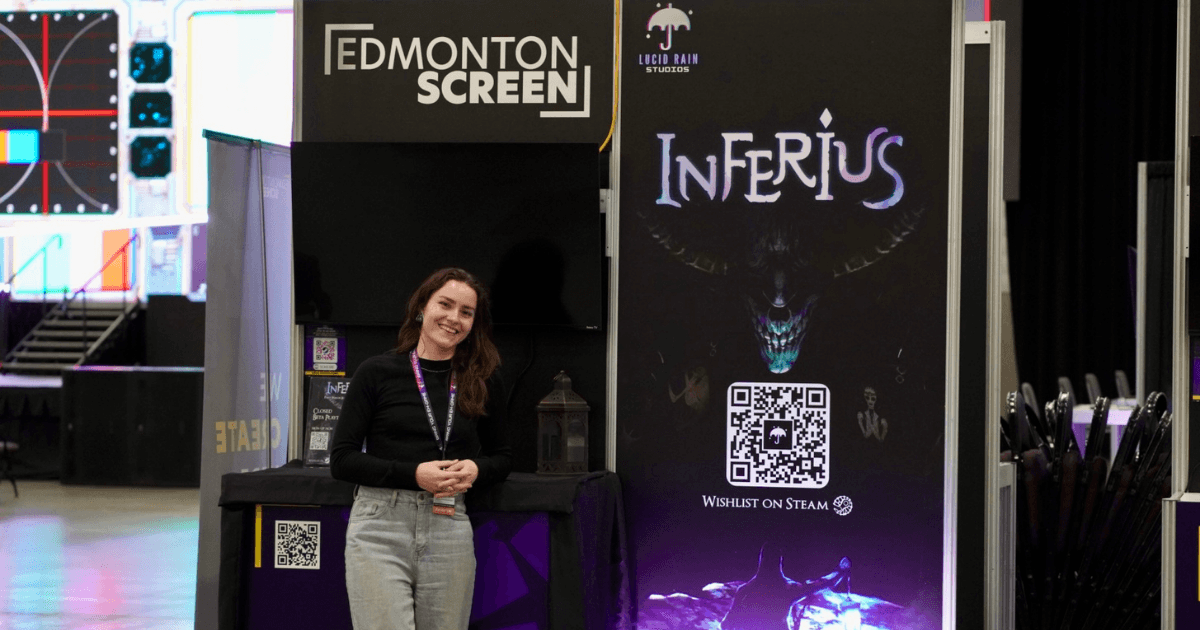
INFERIUS has a Steam page live now for anyone who wants to follow along, and this August you can find Lucid Rain at gamescom in Cologne alongside fellow Summit Push studios, where they'll be meeting publishers, gathering feedback, and building momentum toward launch.
For Martens, one lesson has remained consistent throughout the studio's growth: success in games is rarely something you build alone.
"The industry is so small, and it seems really scary, but it's just a bunch of creators," she says. "It's just a bunch of people making stuff and wanting to make stuff."
It's why she encourages emerging developers to get involved, build relationships, and learn from the people around them.
"That's the biggest thing," she says. "It's the people."